
A Learning Curve
A Learning Curve
Phew. My first couple of months in real estate have definitely been a learning experience.
Hosting open houses has given me the chance to meet people who are all at very different points in their lives. I’ve met first-time buyers trying to understand the process, families who need a little more space, empty nesters looking to downsize, and people moving back to Denver after time away. One of the most enjoyable parts of these open houses has simply been hearing their stories and learning what brought them to the moment of looking for a new home. Even if we never end up working together, I genuinely enjoy making those connections.
I’ve also had the opportunity to take clients from MY Denver Real Estate on showings, which has been a great reminder that every buyer looks at homes a little differently. Some people notice layout first, others focus on natural light, and some immediately start imagining where the couch would go. It has helped me get better at listening to what people love, what they need, and what they might not have realized they were looking for yet.
Another learning curve has been navigating the MLS and pulling comparisons for homes. There are a lot of options on the market right now, which means helping buyers sort through what’s actually a good fit. On any given day, I might be looking at a beautiful single-family home in Park Hill, a spacious townhome in the Highlands, or a condo in Cheesman with views that make you stop for a minute.
And of course, there are the lessons you don’t expect. For example, always turn the lights on before walking into the basement. No ghosts yet, but there are definitely some old bones with stories to tell.
All in all, it has been a fantastic start, and I can’t wait to see what’s next!
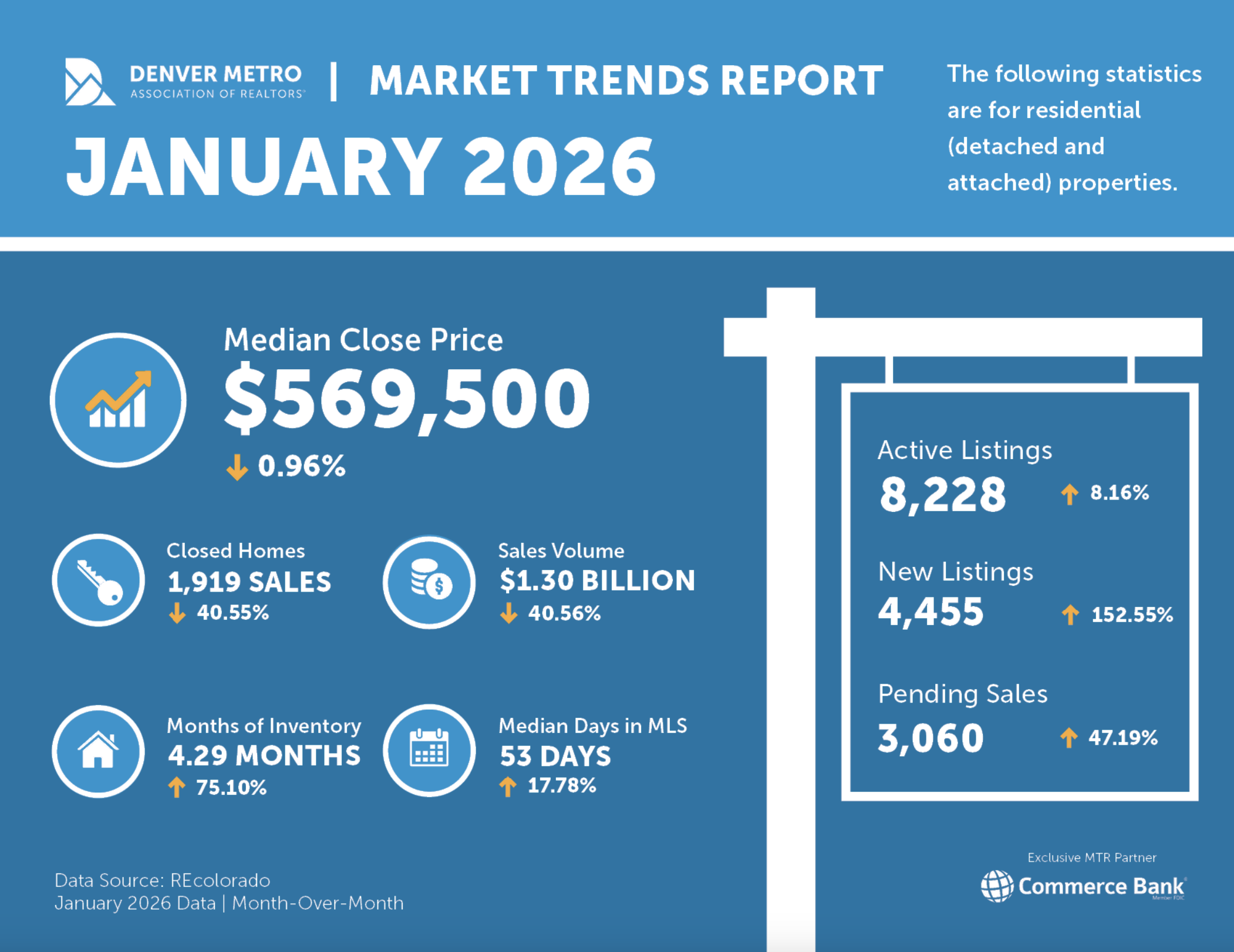
January 2026: A Surprisingly Busy Start to the Year
January 2026: A Surprisingly Busy Start to the Year
If January felt unusually active in Denver real estate, you weren’t imagining it. After a few years of a fairly flat market, 2026 kicked off with more movement than we typically see this time of year. Normally, January is quiet. This year? Not so much.
The Denver housing market entered 2026 with more activity than we typically see this time of year. While the last few years have felt relatively flat, January brought noticeable movement, especially in new listings and buyer activity. Here’s what stood out.
Inventory Is Up
At the end of January, there were 8,228 active listings on the market, an 8.16% increase from December. Historically, inventory usually declines from December to January. This year did the opposite, which tells us sellers came back into the market early. For buyers, that means more options than we’ve seen in recent winters.
New Listings Jumped Significantly
January saw 4,455 new listings, a 152.55% increase month-over-month. Many of these were homes that had been pulled off the market during the holidays and relisted after the new year. That suggests sellers are motivated, but also strategic about timing.
Prices Remain Relatively Stable
The median close price in January was $569,500, down slightly (0.96%) from December. While prices have softened compared to peak pandemic levels, they are not collapsing. Instead, we’re seeing a more balanced environment where pricing accuracy matters more than ever. Well-priced homes are still moving.
Homes Are Taking Longer to Sell
The median days on market increased to 53 days, up 17.78% month-over-month . This doesn’t mean homes aren’t selling. It means buyers are being more deliberate. They’re comparing options and negotiating when appropriate. For sellers, preparation and pricing are critical.
What This Means for Buyers
You have more inventory and slightly more negotiating power than in recent years. However, affordability remains a real consideration. Rates are still elevated compared to pandemic lows, and monthly payment, not just price, is driving decisions. If you’re financially prepared, this type of market can offer an opportunity. There is less frenzy and more room for thoughtful decision-making.
What This Means for Sellers
The market isn’t slow; it’s selective. Homes that are well-prepared, priced realistically, and located in strong neighborhoods are still seeing activity. The difference is that buyers are less willing to overlook condition or overpay. Longer days on market are becoming the norm, not the exception.
The Bigger Picture
After three years of relatively flat performance, the Denver market appears to be searching for direction. Activity increased significantly in January, but major structural changes are not expected immediately. Rather than waiting for dramatic shifts, buyers and sellers may find that acting when personal timing aligns is more important than trying to “time the market.”

Starting Something New
Starting Something New
For most of my career, I worked in education and leadership. I began as a teacher, later served as a school principal, and eventually moved into development work. Across those roles, I spent years helping families navigate meaningful, often complex, decisions that required planning, patience, and a clear understanding of the bigger picture.
Real estate was not a lifelong plan or a dramatic pivot. It became part of my path through lived experience.
In 2021, I purchased my first home in Denver. I approached the process prepared. I had done my research, asked thoughtful questions, and believed I understood what to expect. Even so, there were moments that felt layered and fast-moving in ways I hadn’t anticipated. Contracts, timelines, finances, and emotion all converge at once in a real estate transaction, and even when everything is handled well, the pace and complexity can feel significant.
What stood out to me during that experience was not frustration, but the impact of clarity. The moments that felt manageable were the ones where the process was explained thoughtfully, and the next step was clear. When someone slowed things down and provided context, the entire experience shifted.
That realization stayed with me.
Around the same time, I began thinking more intentionally about the long-term direction of my career. I knew I wanted to continue working in spaces rooted in trust, communication, and strategy. I wanted to remain in roles where preparation mattered and where steady guidance could genuinely change someone’s experience. Real estate, when practiced thoughtfully, offered exactly that. Buying or selling a home requires people to weigh tradeoffs, consider long-term implications, and move forward with confidence despite uncertainty. Those conversations require listening more than talking, structure more than pressure, and perspective more than urgency.
My background in education and leadership did not disappear when I transitioned into real estate. It informs how I approach every client relationship. I am comfortable explaining complex systems in clear terms, helping people organize their thinking, and staying steady when decisions feel high-stakes. More than anything, I understand that clarity is not a luxury in this process; it is essential.
That is ultimately why I made the shift. Real estate felt aligned with the work I have always done, guiding people through important moments with thoughtfulness, preparation, and care. My goal is to ensure that the process feels structured, informed, and grounded from the very beginning.